

Prerequisites
- Git
- A CometAPI account with an active API key
- A terminal on macOS, Linux, or WSL2
Installation
1
Get your CometAPI API key
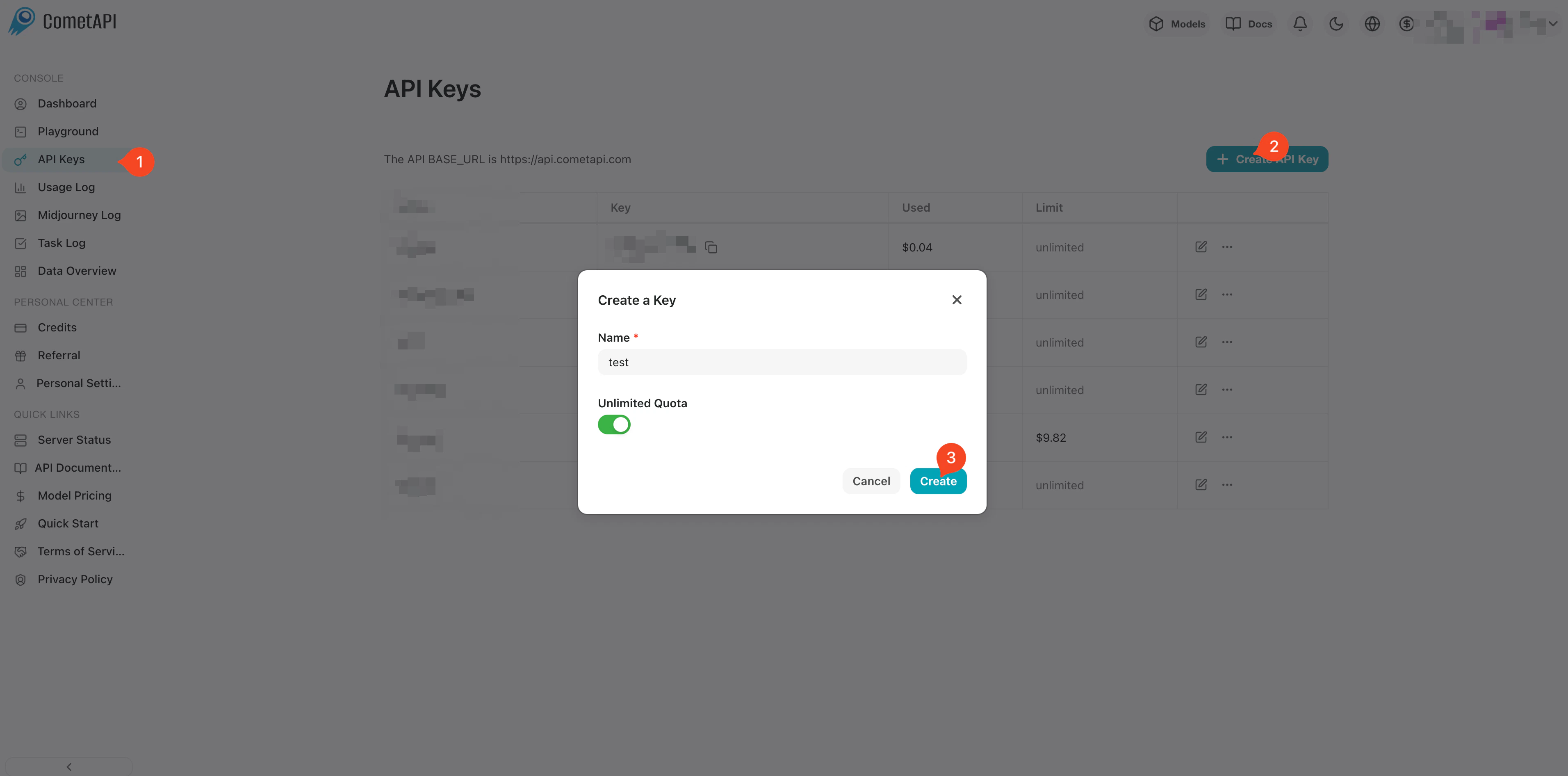
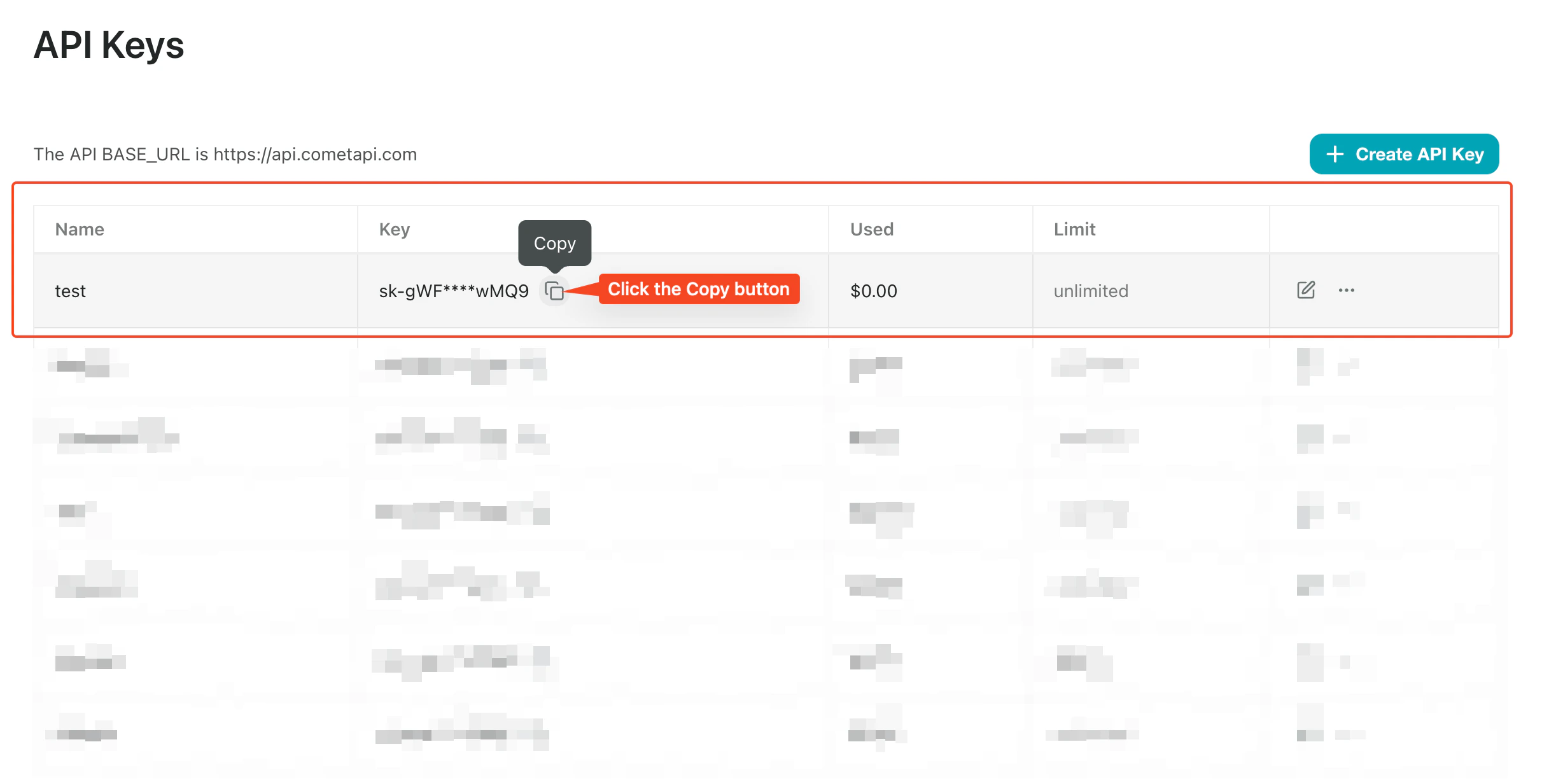
2
Install Hermes Agent
The following command runs the official installer:If the current shell does not see the
hermes command yet, reload the shell configuration:Hermes stores config in
~/.hermes/, links the hermes command in ~/.local/bin, and may add ~/.local/bin to your shell PATH.Configuration
Choose the CometAPI route that matches the model family:1
Store your CometAPI key
Open
~/.hermes/.env and add the following values:COMETAPI_KEY is used by the named Claude provider. OPENAI_API_KEY keeps Hermes’s custom OpenAI-compatible endpoint fallback working.2
Configure the OpenAI-compatible route
Use this route for most CometAPI text models, including Gemini models used from Hermes. Open Replace
~/.hermes/config.yaml and make sure the model section looks like this:your-model-id with a current text model ID from the CometAPI Models page.Keep the API key in
~/.hermes/.env. Do not hardcode secrets in config.yaml.This setup configures the main chat model. Hermes can use separate auxiliary models for tasks such as vision or web extraction.
3
Configure the Claude Messages route
Use this route when you want Hermes to call Claude models through Anthropic Messages. Open Replace
~/.hermes/config.yaml and use a named provider:your-claude-model-id with a current Claude model ID from the CometAPI Models page.Keep
base_url at https://api.cometapi.com for this route. Hermes uses the Anthropic Messages transport from the named provider.Verification
1
Check the configuration
The following command confirms that Hermes can read the config and the API key:If
hermes config check reports missing options after an update, run hermes config migrate and check again.2
Run a real chat test
The following command sends a real request through CometAPI:A successful setup returns
CONNECTED and no auth or endpoint errors. When the Claude Messages configuration is active, this confirms that Hermes can use the anthropic_messages transport through CometAPI.Optional configuration
Clean reinstall (optional)
Clean reinstall (optional)
If you are replacing an older Hermes install, use the built-in uninstaller first:In the uninstaller, choose Full uninstall to remove the CLI, PATH entry, and
~/.hermes/ data. Then rerun the install step and continue with the same CometAPI configuration.Use hermes model instead (optional)
Use hermes model instead (optional)
If you prefer the interactive flow for the OpenAI-compatible route, run
hermes model and choose Custom endpoint.Then enter the following values:- Base URL:
https://api.cometapi.com/v1 - API key: your CometAPI API key
- Model: a current CometAPI text model ID
config.yaml. For Claude Messages, edit config.yaml directly so the named provider keeps transport: anthropic_messages.